Lately I’ve been reading and listening to four authors: Robin Wall Kimmerer, Henri Bergson, Iain McGilchrist, and Martin Buber. Let’s begin by taking a look at an excerpt from page 178 of Kimmerer’s book Braiding Sweetgrass:
“Asking permission shows respect for the personhood of the plant, but it is also an assessment of the well-being of the population. Thus I must use both sides of my brain to listen to the answer. The analytic left reads the empirical signs to judge whether the population is large and healthy enough to sustain a harvest, whether it has enough to share. The intuitive right hemisphere is reading something else, a sense of generosity, an open-handed radiance that says take me, or sometimes a tight-lipped recalcitrance that makes me put my trowel away. I can’t explain it, but it is a kind of knowing that is for me just as compelling as a no-trespassing sign. This time, when I push my trowel deep I come up with a thick cluster of gleaming white bulbs, plump, slippery, and aromatic. I hear yes, so I make a gift from the soft old tobacco pouch in my pocket and begin to dig.”
The context of this passage matters. Robin Wall Kimmerer is an Indigenous American, a member of the Potawatomi tribe. She earned a PhD in Botany from the University of Wisconsin at Madison and is currently a Professor at the State University of New York at Syracuse. Her book Braiding Sweetgrass is brilliant; speaking largely in metaphor, she distills a vision of personhood that sanctifies all living.
Kimmerer’s writing is rich in content and meaning. First, “the personhood of the plant” is a remarkable statement. She is not limiting a “person” to members of the species Homo sapiens, but rather regards plants as persons in the sense of having agency as a living being. Every plant is alive, every plant has agency. Seen this way, every plant is person and deserves to be treated with dignity and respect. She goes on to state that in respecting the personhood of this plant she can come to know “(t)he well-being of the population” of not only this plant but all plants.
To know the health of this plant, this person, is to begin to know the overall health of all plants, of all persons. This is a philosophy of living that opens doors to authentic connection. In knowing this person before me I come to know all persons. Each moment of connection contains a surfeit of meaning and potential.
Continuing with this passage, she states that she must use “both sides of my brain” in order to truly listen to these persons. This brings us to Bergson who I’ve written about before, enthused and informed by his philosophical insight in the early part of the 20th century that we have two fundamental ways of knowing and experiencing the world: analysis and intuition. McGilchrist, writing in 2009 (The Master and His Emissary) and in 2021 (The Matter With Things), drew significantly on Bergson’s philosophy in developing his brain hemisphere hypothesis: the left hemisphere is primarily analytical while the right hemisphere is primarily intuitive. Kimmerer captures these ways of knowing in her subsequent sentences:
“The analytic left reads the empirical signs to judge whether the population is large and healthy enough to sustain a harvest, whether it has enough to share. The intuitive right hemisphere is reading something else, a sense of generosity, an open-handed radiance that says take me, or sometimes a tight-lipped recalcitrance that makes me put my trowel away. I can’t explain it, but it is a kind of knowing that is for me just as compelling as a no-trespassing sign.”
Bergson’s insight that our minds are generally either analyzing the world to assess fitness and safety or intuitively receiving and perceiving the world in an observational and non-judgmental way was prescient of McGilchrist’s “hemisphere hypothesis.” Kimmerer extends this further in her assertion that to truly know another person it is the intuitive mind, the right hemisphere, that must do the knowing.
Today, when you meet another person, see if you can catch yourself analyzing them rather than receiving them by truly listening to them. As Wittgenstein implored, “Don’t think, just look.” Simply listening to another person without working through your own thoughts about what to say next will lead to the revelation of who this person actually is. And that includes if this person is a plant-person.
Kimmerer continues:
“This time, when I push my trowel deep I come up with a thick cluster of gleaming white bulbs, plump, slippery, and aromatic. I hear yes, so I make a gift from the soft old tobacco pouch in my pocket and begin to dig.”
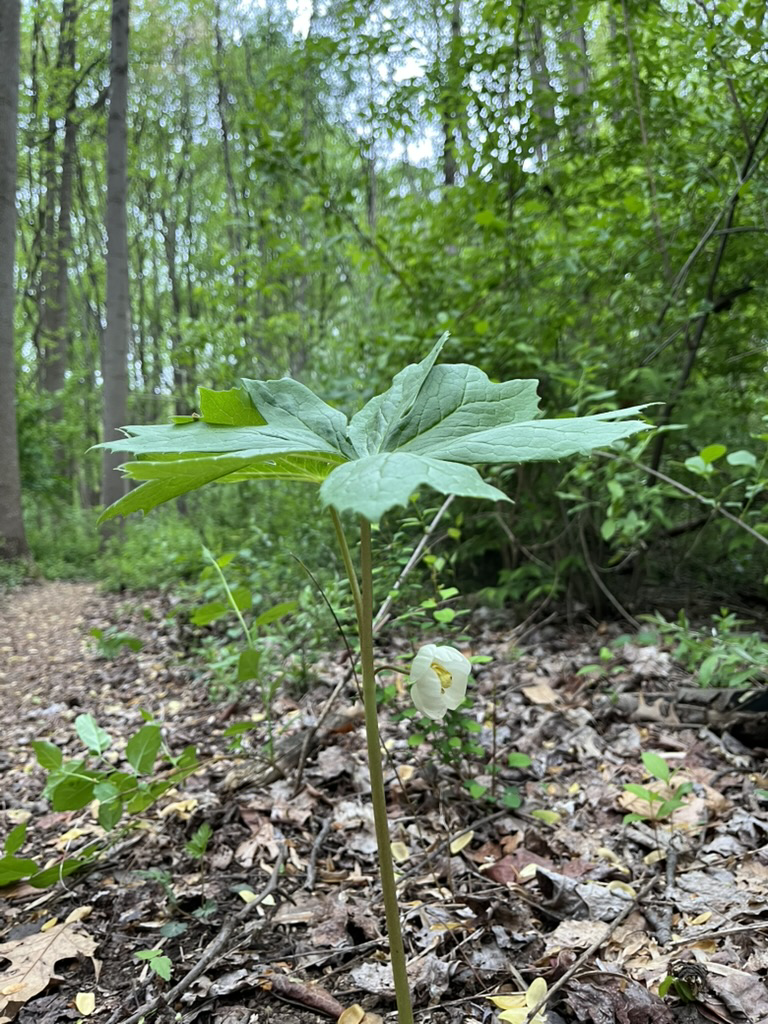
She is in the woods searching for wild leeks that are ready to harvest. Her attitude toward the leeks is the opposite of transactional, an exchange of commodities. In such a transaction we give and we get, but no intimacy in the relationship results. We are simply doing business. Earlier Kimmerer quoted the scholar Lewis Hyde from his book The Gift:
“… The cardinal difference between gift and commodity exchange is that a gift establishes a feeling-bond between two people.”
Kimmerer has established a feeling-bond with the wild leeks in the woods by seeing their interaction not as transaction but as gift. In gifting persons exchange gifts, not commodities, in this case a gift of tobacco, whose smoke is believed by Indigenous Americans to act as a bridge between persons and the spiritual realm. The leek gifts its very essence, its root bulb; Kimmerer gifts connection to the sacred in return, and the exchange creates the feeling-bond of kinship between persons.
The feeling-bond in connection is evidence of presencing, a word I first encountered in McGilchrist’s The Matter With Things. Presencing is an experiencing of another person while you make yourself fully available to be experienced by them. In presencing there is an intimacy that is best understood as gift-exchange. My time, attention, smile, empathy and authenticity are given freely, along with unconditional acceptance and positive regard. These are simple gifts always at our disposal. As we manifest these gifts to one another a feeling-bond emerges. Another name for this gifting, this presencing, is love.
Reading Kimmerer easily brought Bergson to mind as she clearly writes from her deepest intuitive self. When she named her analytical left hemisphere and intuitive right hemisphere the connection to McGilchrist’s hemisphere hypothesis was immediate, and the reference grounded her way of knowing plants in current neurobiology research. But another author came to mind reading Kimmerer: Martin Buber, the German theologian and philosopher. Buber wrote his classic I and Thou in 1923 as a critique of the objectification of relationships, which he refers to as “I – It” relationships. An “I – Thou” relationship is intimate and authentic, in which persons experience unity, oneness, and love. In I and Thou Buber states:
All real living is meeting.
Or, put another way: All real living is presencing.
“Presencing” isn’t actually a real word, it is a neologism (a made-up word). But it is a neologism that captures something important in any authentic connection between persons. When we can let go of our persistent need to figure things out, to figure this person out, when we can just receive this person without judgment or opinion or needs of our own, then we are fully present. But “fully present” seems like some thing to attain, where “presencing” feels like a way of being in this moment of encounter. It just seems more real to me than striving to be fully present. By focusing on presencing with this person in front of me I acknowledge that I will drift back to analysis, simply a human inevitability that minds will drift, but then I can mindfully notice the drift and drift back to presencing by my noticing and not judging myself. Now I am really living with this person; now we are actually meeting.
And in truly meeting I am “direct experiencing” this person. My sense perceptions are alive in the moment while my thoughts and opinions and preconceived notions and conditioned responses are at rest. All that is left is my experience, my intuitive mind’s way of knowing the world.
And that leaves co-direct experiencing. At this point it is likely that no further explanation is needed. By presencing, by direct experiencing, a gift is given, an invitation is made. Co-direct experiencing may emerge, and the living becomes meeting, and the meeting is loving.
Postscript: The phrase “open-handed radiance” is luscious. Kimmerer uses it to illustrate the felt-quality of the intuitive mind. Words evade me; for now I’ll just let it stand on its own. Maybe one day I will be able to write about this.
Peace,
Jim
 James M. Walsh Pastoral Counseling