It was a painful winter this year in Delaware. Very cold, unreasonably and unseasonably cold if you ask me. My greatest grievance was with the layer of ice that covered the nine inches of snow that fell in late January. That ice encased the snow quite snugly leaving behind a white skating rink on all unplowed surfaces, which included the trails in the forest where I love to wander about. No hiking from mid January until early March. It hurt.
After a hike or two in March on trails muddied from the rapid melting, I headed to points south with my wife for two weeks to get some warmth and sunshine. We had a good respite, with visits to friends and family and a long ride home up the east coast. By late March I was able to resume hiking, but much to my chagrin my memory failed me when I needed it most! Allow me to explain.
Every year in early spring there is a sequential reemergence of life: first a haze of green across the forest floor as the bushes and underbrush begin to grow, followed by a haze of green across the horizon of treetops as leaf buds emerge slowly, usually a week or so behind those lower horizons. As the snow melts the streams coursing through the forest gush more strongly, a sound that calls you deeper into your hike and your thoughts. Birds return, squirrels skitter, and hikers, dog walkers, trail bikers and children on field trips cross your path once again.
And then they emerged: these odd plants, low to the ground, always with five leaves forming an umbrella shape, the late March plants that I’ve seen every year over the past three decades in the woods along the trails, and for the life of me I could not remember their name! My mind was a blank. I went through the alphabet hopelessly trying to find a clue. I wracked my brain; it was painful! Over the course of three hikes in one week I had no clue whatsoever when I tried to remember; the harder I tried, the worse it became.
Then I heard an inner voice speak to me; it was Ludwig Wittgenstein to the rescue. Wittgenstein, born in Vienna in 1889, was an acolyte of Bertrand Russell before the outbreak of the “Great War” but broke with Russell for a variety of philosophical reasons and went his own way. He fought in the German army in that awful time, and never developed a particular philosophical school of his own. During his lifetime he published one book, his Logical-Philosophical Treatise, a mere 75 pages in length. He was best known as a philosopher of mathematics, mind, and language. His output published during his lifetime was spare, yet he was revered as a profound teacher and his reputation has grown since his death in 1951 with the posthumous publication of many books and treatises. For those of us who love philosophy but are not trained in the discipline, we may know him best by a simple phrase from one of those posthumously published books, Philosophical Investigations: “Don’t think, but look!”
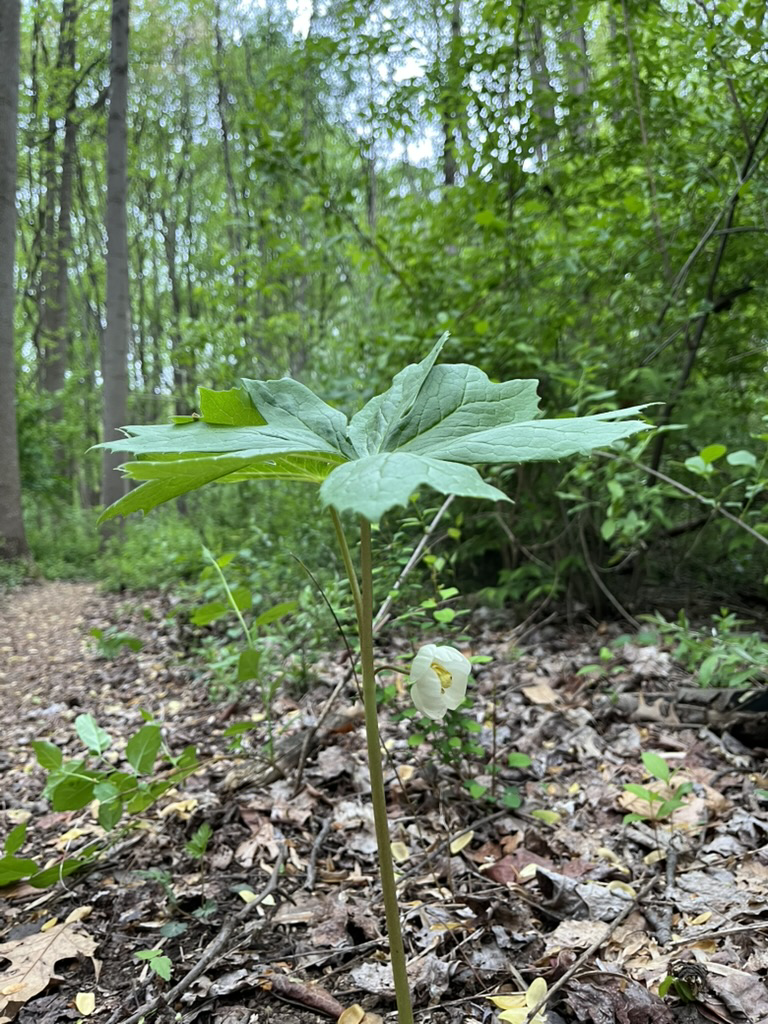
Like the thunderclap that wakes you up, makes you alert, and perhaps takes your breath away, Wittgenstein’s forceful admonition to stop thinking shook me out of my analytical stupor and into a state of free floating mindful attention. There was no particular focus of mind now, only relaxed awareness gazing about the woods, feeling my feet on the ground, seeing the trees and the foliage, smelling the fresh air and woodsy scents; in sum, only visceral sensual experiencing without having to figure anything out. And within a minute or two the word “mayapple” flashed before my eyes, and the tension of memory withheld vanished like a wisp of smoke in the wind. And for the curious, here is a mayapple I saw in those woods that day:
So what is my point? Let’s go back again to Intuition and Mindfulness, the topics of my prior posting. In that essay I discussed the two ways of knowing things (epistemology to a philosopher by the way) described by Henri Bergson: analysis and intuition. Analysis is important; it is the seat of intellect, the foundation of “figuring stuff out.” From an evolutionary point of view it is our mind’s way of determining safety vs. risk, useful vs. wasteful, important vs. trivial. Each of us spends a lot of time each day in our analytical minds, and that’s mostly fine.
But we also have a mind that knows the world more directly, our intuitive mind, the seat of intelligence. This mind perceives our world directly without analyzing it, just “looks” in the way Wittgenstein demands. This is the mind that savors the taste of a good meal, not deducing its salt, fat, acid and heat contents. The intuitive mind hears a piece of music or a baby’s giggle or the sound of the wind whooshing through the tree limbs without trying to decode meaning or structure. We are able to feel without interpreting, smell without judging, move through our life living to the full without the energy sapping analysis that can blind us to the moment-to-moment blissful awareness that the world invites us to imbibe. And it was in this state of mind that the word “mayapple” was released by my memory to my conscious awareness and I was able to have a good laugh and think to myself “well the old guy hasn’t lost all of his marbles yet.”
How often do we go through a day without being fully present, not simply perceiving our world and allowing the happiness that nature, that God, has in store for us in the simplest of realizations. In a previous essay (“Walking with Thoreau”) I quoted Thomas Merton from his book “Thoughts in Solitude.” That quote comes to mind again, and is worth repeating:
“To deliver oneself up, to hand oneself over, entrust oneself completely to the silence of a wide landscape of woods and hills, or sea, or desert; to sit still while the sun comes up over that land and fills its silences with light.”
That stillness that Merton writes of is not to be found by simply not moving. Instead Merton’s stillness demands more: one must be fully attuned through intuition to this time, this place, these events, this person. Perceiving rather than analyzing, looking rather than thinking. In those moments we might actually come to know something deeper than we’ve ever known before. And, in an uncanny way, we may feel known by the very landscape we find ourselves perceiving. We might even delight in the sight of a mayapple in blossom.
Peace,
Jim

