Categories
Mindfulness Meditation

Seeing Mayapples: Don’t Think, but Look!

It was a painful winter this year in Delaware.  Very cold, unreasonably and unseasonably cold if you ask me.  My greatest grievance was with the layer of ice that covered the nine inches of snow that fell in late January.  That ice encased the snow quite snugly leaving behind a white skating rink on all unplowed surfaces, which included the trails in the forest where I love to wander about.  No hiking from mid January until early March.  It hurt.

After a hike or two in March on trails muddied from the rapid melting, I headed to points south with my wife for two weeks to get some warmth and sunshine.  We had a good respite, with visits to friends and family and a long ride home up the east coast.  By late March I was able to resume hiking, but much to my chagrin my memory failed me when I needed it most!  Allow me to explain.

Every year in early spring there is a sequential reemergence of life: first a haze of green across the forest floor as the bushes and underbrush begin to grow, followed by a haze of green across the horizon of treetops as leaf buds emerge slowly, usually a week or so behind those lower horizons.  As the snow melts the streams coursing through the forest gush more strongly, a sound that calls you deeper into your hike and your thoughts.  Birds return, squirrels skitter, and hikers, dog walkers, trail bikers and children on field trips cross your path once again.

And then they emerged: these odd plants, low to the ground, always with five leaves forming an umbrella shape, the late March plants that I’ve seen every year over the past three decades in the woods along the trails, and for the life of me I could not remember their name!  My mind was a blank.  I went through the alphabet hopelessly trying to find a clue.  I wracked my brain; it was painful!  Over the course of three hikes in one week I had no clue whatsoever when I tried to remember; the harder I tried, the worse it became.

Then I heard an inner voice speak to me; it was Ludwig Wittgenstein to the rescue.  Wittgenstein, born in Vienna in 1889, was an acolyte of Bertrand Russell before the outbreak of the “Great War” but broke with Russell for a variety of philosophical reasons and went his own way.  He fought in the German army in that awful time, and never developed a particular philosophical school of his own.  During his lifetime he published one book, his Logical-Philosophical Treatise, a mere 75 pages in length.  He was best known as a philosopher of mathematics, mind, and language.  His output published during his lifetime was spare, yet he was revered as a profound teacher and his reputation has grown since his death in 1951 with the posthumous publication of many books and treatises.  For those of us who love philosophy but are not trained in the discipline, we may know him best by a simple phrase from one of those posthumously published books, Philosophical Investigations: “Don’t think, but look!”

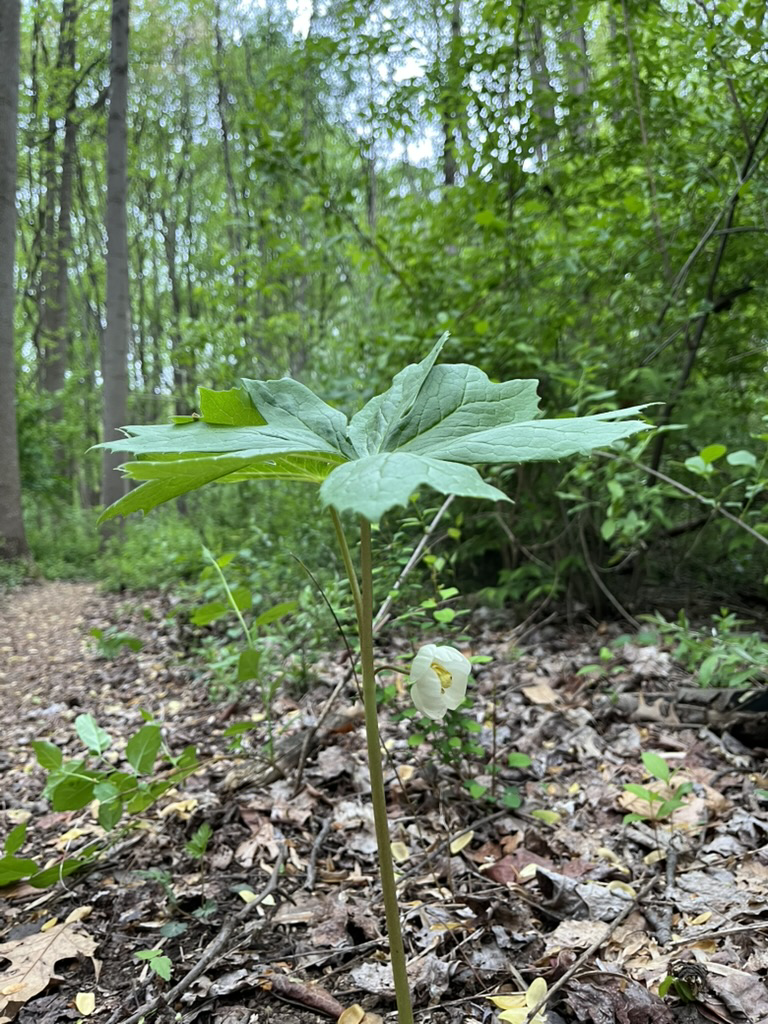
Like the thunderclap that wakes you up, makes you alert, and perhaps takes your breath away, Wittgenstein’s forceful admonition to stop thinking shook me out of my analytical stupor and into a state of free floating mindful attention.  There was no particular focus of mind now, only relaxed awareness gazing about the woods, feeling my feet on the ground, seeing the trees and the foliage, smelling the fresh air and woodsy scents; in sum, only visceral sensual experiencing without having to figure anything out.  And within a minute or two the word “mayapple” flashed before my eyes, and the tension of memory withheld vanished like a wisp of smoke in the wind.  And for the curious, here is a mayapple I saw in those woods that day:
So what is my point?  Let’s go back again to Intuition and Mindfulness, the topics of my prior posting.  In that essay I discussed the two ways of knowing things (epistemology to a philosopher by the way) described by Henri Bergson: analysis and intuition.  Analysis is important; it is the seat of intellect, the foundation of “figuring stuff out.”  From an evolutionary point of view it is our mind’s way of determining safety vs. risk, useful vs. wasteful, important vs. trivial.  Each of us spends a lot of time each day in our analytical minds, and that’s mostly fine.

But we also have a mind that knows the world more directly, our intuitive mind, the seat of intelligence.  This mind perceives our world directly without analyzing it, just “looks” in the way Wittgenstein demands.  This is the mind that savors the taste of a good meal, not deducing its salt, fat, acid and heat contents.  The intuitive mind hears a piece of music or a baby’s giggle or the sound of the wind whooshing through the tree limbs without trying to decode meaning or structure.  We are able to feel without interpreting, smell without judging, move through our life living to the full without the energy sapping analysis that can blind us to the moment-to-moment blissful awareness that the world invites us to imbibe.  And it was in this state of mind that the word “mayapple” was released by my memory to my conscious awareness and I was able to have a good laugh and think to myself “well the old guy hasn’t lost all of his marbles yet.”

How often do we go through a day without being fully present, not simply perceiving our world and allowing the happiness that nature, that God, has in store for us in the simplest of realizations.  In a previous essay (“Walking with Thoreau”) I quoted Thomas Merton from his book “Thoughts in Solitude.”  That quote comes to mind again, and is worth repeating:

“To deliver oneself up, to hand oneself over, entrust oneself completely to the silence of a wide landscape of woods and hills, or sea, or desert; to sit still while the sun comes up over that land and fills its silences with light.”

That stillness that Merton writes of is not to be found by simply not moving.  Instead Merton’s stillness demands more: one must be fully attuned through intuition to this time, this place, these events, this person.  Perceiving rather than analyzing, looking rather than thinking.  In those moments we might actually come to know something deeper than we’ve ever known before.  And, in an uncanny way, we may feel known by the very landscape we find ourselves perceiving.  We might even delight in the sight of a mayapple in blossom.

Peace,

Jim

Categories
Mindfulness Meditation

Intuition & Mindfulness Again

Last year I posted an essay that was a dialog between me and the AI Assistant from Anthropic, Claude. Looking back it seems like a clumsy way to present ideas about Intuition, as understood by Henri Bergson, and Mindfulness. So I have refashioned that work into an actual essay that I hope you find helpful.

I am currently reading the works of the French Philosopher Henri Bergson, beginning with “An Introduction to Metaphysics.”  Bergson, born in 1859, was instrumental in bringing Philosophy to the masses, or at least the Parisian masses, especially during the first decade of the 20th century.  His influence waned after World War I, but there is renewed interest in his work.  What fascinates me most about his work on metaphysics is its resonances with humanistic psychotherapy, particularly around his core distinction between analysis and intuition as ways of knowing.  In “An Introduction to Metaphysics,” Bergson argues that analysis can only give us fragmented, static representations of reality, while intuition allows us to apprehend the flowing, dynamic nature of lived experience from within. This maps remarkably well onto the difference between diagnostic/analytical approaches to therapy and the phenomenological stance of humanistic work.

Bergson’s idea of intuition denotes a direct and unmediated experiencing of the unfolding of reality in time, whereas analysis is mediated by intellect and experiences temporal reality mathematically; that is, time is seen as being inherently measurable rather than a seamless sense of duration.  It’s important to note that Bergson’s definition of intuition differs from the colloquial understanding of a “gut feel,” which suggests “taking a good guess.”  Rather, to Bergson intuition is the capacity to understand something without conscious reasoning.  As such it is clearly a “present moment” awareness rather than an analysis over a measurable period of time.

When the therapist invites a client to notice their present-moment experience – for instance asking a client about what came up when discussing childhood trauma – the client is encouraged to engage what Bergson would call intuitive knowledge. Rather than analyzing one’s reaction from the outside, the client comes to know her experience from within its own flow and movement.

This process assumes something important about time.  We are conditioned to “see” time as a measurable commodity, as mechanical, rather than experience time as something that flows seamlessly along like the current of a river.  Bergson names this alternate way of experiencing time “durée,” most often translated into English as “duration,” which can be thought of as “lived time.”

Bergson’s concept of “durée” versus mechanical time also speaks to the therapeutic process. Clock time moves through discrete, measurable units, but lived time expands and contracts based on the quality of experiencing. In therapy, a moment of genuine encounter within the flow of time can contain more healing than hours of technique-driven intervention caught within a more mechanistic and measured experience of time.

From a genuine encounter in lived time the experience of authentic presence flows naturally.  This is true not only in therapy but in any human encounter.  This kind of presence creates a relationship space in which people can begin to see themselves in their wholeness rather than their brokenness.  I believe that this is where mindfulness practice is helpful.  Being mindfully aware and awake, noticing, naming, normalizing, not judging, simply being fully present, diminishes the self-consciousness that shame engenders.  Our mindfulness practice helps us to engage authentic presence in “lived time” rather than analyzing in “mechanical time,” and that allows for humane responses to ours, and other’s, human experiences.

Here’s a story I’ve told countless times that illustrates this point.  Several years ago I was at the checkout in a supermarket when the young woman working at the register was rude to me for no discernible reason.  Anger flashed quickly, followed closely by a mindful pause: noticing, naming, normalizing and accepting my feeling state, thus defusing the impulse and its typical angry behavior.  In that pause time shifted – from the rushed, mechanical rhythm of checkout lines to a moment of genuine encounter.  I was able to see for the first time her anguish, which I missed while my eyes were dimmed by the filter of anger.  I said “you were just rude to me for no reason.  Are you ok?”  The change in her body language was palpable: she seemed stunned by my question.  She began to cry softly, and said that her five year old son was sick and couldn’t go to school today.  She couldn’t find a babysitter; she eventually did and got to work late.  “This has happened before; please don’t tell my boss I was rude.  I need this job.  I’m a single mom.  I can’t get fired.”  Now instead of anger there was only compassion.  She wasn’t simply rude, she was suffering.  And the humane response to suffering is compassionate caring, which I was able to extend by simply saying a few words of comfort and encouragement, and letting her know I would pray for her.  When I left she had dried her tears and thanked me for being understanding.  The net effect was I left the store in a calm body rather than an angry body and perhaps she felt some hopeful encouragement as well.  All in all a better outcome than my anger, mindless anger, would have created.

I believe that this story connects well with Bergson’s durée and intuition:

  • The pause between anger and response is exactly that shift from “mechanical time” (reactive, automatic) to “durée” (present, flowing awareness);
  • My mindfulness practice created the space to move from analytical categorization (“rude cashier”) to intuitive understanding of her lived experience (“suffering mother”);
  • The story shows how presence in “lived time” allowed me to see her wholeness rather than just the brokenness manifest in her surface behavior; and
  • The transformative moment when I asked “Are you ok?” was pure Bergsonian intuition – I apprehended her reality from within her experience rather than analyzing it from outside.

This is what I have come to love in Bergson’s thought: his understanding of intuition and lived time as distinct from analysis and mechanical time connects so deeply with the mindfulness practice I have embraced and taught for over twenty years.  It is not only therapists who can benefit from mindfulness and Bergson’s metaphysics: we all can, especially in this fragmented world.  Instead of identifying people as “other” we can pause, shift from analysis to intuition, from mechanical time to duration, and perhaps really listen to each other, and feel caring rather than judgment.

What strikes me about this exploration is how Bergson’s century-old insights remain so immediately relevant to our contemporary struggles with presence and connection. In a world increasingly dominated by digital fragmentation and mechanical rhythms, his distinction between analytical categorization and intuitive understanding offers a pathway back to genuine encounter.

The supermarket story demonstrates that these aren’t merely abstract philosophical concepts – they’re practical tools for transforming how we meet each other in the most ordinary moments. When we learn to pause and shift from mechanical time into durée, we create space for the kind of human recognition that can change both participants in an encounter.

Perhaps most importantly, this shows how mindfulness practice and Bergsonian philosophy converge on the same insight: that our capacity for compassionate presence is not just a therapeutic technique, but a fundamental way of being that can restore our sense of shared humanity.

Peace,

Jim

Categories
Mindfulness Meditation

Am I really retired?

Well, yes and no.  Let me explain.

On the one hand I’ve closed my private practice, long ago left my full time faculty position at Wilmington University, I do very few workshops for the state’s Division of Substance Abuse and Mental Health, I stopped doing psycho-forensic evaluations for the Office of the Public Defender, and even stopped teaching Mindfulness Based Stress Reduction.  That sounds like I’ve really retired!

But, on the other hand, I am still teaching as an adjunct professor in that same graduate program at Wilmington University, I provide clinical supervision to graduate-level interns along with clinical supervision and consultation to an assortment of professional counselors and clinical social workers, and, best of all, I travel to Limen House in Wilmington four times a month to provide mindfulness training and to facilitate a process group. All in all I have found a good balance between “retired time” (e.g. reading, hiking, a little golf now and then, and time with the grandchildren) and keeping a hand in the field that I love, Pastoral Counseling.

One might ask “why continue to do ANY work at all?”  I’ve learned that when your work feels playful it’s not work at all.  I’ve also learned that when your work provides a sense of ongoing meaning and purpose, then it’s a labor of love and joy.  I can illustrate that by telling you about the mindfulness session I led at Limen House this morning.

The Women’s House was lightly populated today at 9 am, as most residents had an appointment or a work opportunity.  At the start of the session there were three attendees, including a woman who had only been there for three days, so she was unfamiliar with me and with mindfulness.  About 40 minutes into the meeting two members who had been out for an appointment returned, so by the time we did the actual meditation, which lasted for 10 minutes, there were five attendees.

In our previous meeting nine days earlier, a process group meeting, I had introduced a teaching about the three Jewels of Buddhism: the Buddha, the Dharma, and the Sangha.  I am not a Buddhist, and I’m certainly not teaching Buddhism to the residents of this long-term addiction residential recovery facility, but there is a purpose here.  Buddhists state that they “take refuge in the Buddha, the Dharma, and the Sangha.”  One can loosely  translate these three refuges in these ways:

First, the “Buddha” for a non-Buddhist would be an exemplar one seeks to model oneself after.  That might be one’s Higher Power or God.  Or maybe a mentor or one’s sponsor in a 12 Step group. One woman said her “Buddha” was her family, especially her mother and daughter.  And, of course, there were several women who defined their “Buddha” as Jesus of Nazareth.

The second refuge, the Dharma, refers to the teachings of the Buddha or, perhaps, the teachings one chooses to follow to live a moral and holy life.  Several woman noted the Big Book of AA and the 12 Step principles and practices as their “Dharma.”  Others named the Christian Gospels and the Hebrew Scriptures.  Every woman agreed that one must find a source of wisdom and guidance to live one’s best life.

The third refuge, the Sangha, refers to the Buddhist community.  I redefined that as the fellowship that one needs in order to feel supported throughout one’s recovery from addiction.  The women easily saw that their primary Sangha was Limen House itself, what they called the “Limen House Bubble,” a safe place to get healthy again.  They also cited the 12 Step rooms they attend along with the therapy spaces where they work on their mental health and addiction issues.  A few cited close friendships and family ties as their “Sangha.”

The conversation this morning about finding a refuge during the difficult early days of addiction recovery was a rich dialog with deep sharing.  I encouraged the women to use the teaching about the Three Jewels a a guide in finding refuge.  As I heard the women talking about the need for refuge, for safety, in order to address their addiction issues and their experiences of trauma in much of their lives, I thought of my own needs for refuge and how I am surrounded by so many sources of that safety.  I have the fellowship of a family that loves and supports me.  I have mentors who have been true exemplars of the kind of person I aspire to be.  I have had teachings from so many sources over the years and continue to find new voices that guide me and challenge me to go deeper.  And I have friends, dear friends, who are willing to share their deepest thoughts and feelings and receive mine in return.  Filled with passion for my field and the work I am privileged to do, I left Limen House this morning renewed and revivified once again.

I pose this question to you:  what are your refuges?  Who is an exemplar of the kind of life you aspire to live?  What are the teachings that guide you?  Where do you find the fellowship you need to travel the spiritual pathway you’ve chosen?  These are good questions to consider and, if you are struggling in any one of the three, then perhaps your struggle will lead you to find the support and guidance you need going forward.

So, am I really retired?  I suppose not, though I work fewer hours than before and I earn much less income than ever.  But if retired means letting go of the connections I have to a field that I love, then I want no part of retirement.  I suppose my wife is right: “he is ‘kind of’ retired.”  And, I believe, that is as it should be.

Peace,

Jim

Categories
Mindfulness Meditation

Saying “Hello” again

So I’ve had a change of mind, and am renewing my subscription to WordPress for another year. There are a variety of reasons for this reversal, but mainly I believe I still have something to say and that the content contained herein may still be helpful to people. So thanks for bearing with me and best wishes for a mindful year in the midst of the chaos in the world at present.

Peace,

Jim

Categories
Mindfulness Meditation

Time to Say Goodbye!

I’ve kept this blog site up for over 12 years. I initially started this for two reasons. First, to support the people taking my mindfulness courses, as well as people seeking guided meditation resources. Second, to support my therapy clients with information about managing emotions and psychiatric symptoms.

My site was quite active for several years as I was teaching mindfulness, specifically Mindfulness Based Stress Reduction (MBSR), with great regularity. In addition I had an active private practice as a Pastoral Counselor, seeing up to 20 clients per week.

However, times have changed! I closed my private practice in October of 2021 and stopped teaching the eight-week MBSR program at about the same time. At present I am “kind of retired,” still helping out at a local addiction treatment facility along with teaching as an adjunct faculty member at a nearby graduated education program (Wilmington University’s MS Clinical Mental Health Counseling program). I also continue to do clinical supervision and consultation with graduate interns and some local professionals. So I am keeping busy, but leaving plenty of time for long hikes on local trails and, of course, reading.

I’ve not been writing much for a few years now as my inspiration for writing, helping people who are my therapy clients and my MBSR students, has waned. And that’s OK; there is a time for everything under the sun and it’s time for me to redirect myself to other activities.

I hope this blog site has been helpful to you! It is time to close it out, which will happen in a few days. If there is any material on this blog site that you would like to have continued access to please email me (walshjm54@yahoo.com) and I will find a way to send it to you.

So thanks for being a reader here, and my prayers and best wishes go out to all.

Peace,

Jim